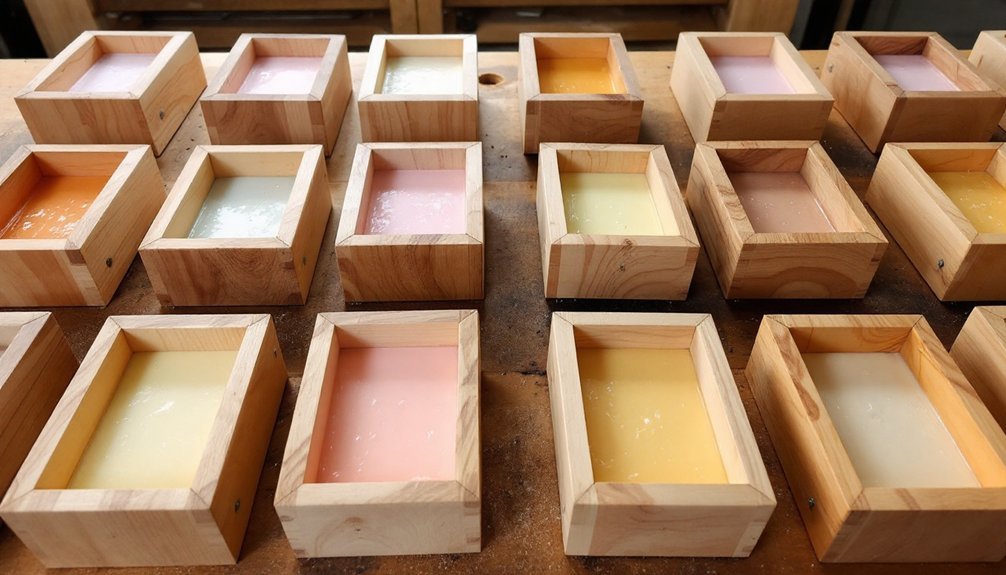
You'll need untreated poplar wood at least 1/2 inch thick, steel bolts, and proper lining materials to build commercial-grade soap molds. Start with standard dimensions of 18 inches length, 12 inches width, and 2.5 inches height for ideal production efficiency. Use freezer paper or silicone liners, and guarantee end boards extend 1 inch above the soap fill level. With proper tools and techniques, you can create professional molds that'll enhance your soap-making operation.
Essential Materials and Wood Selection Criteria

When crafting your own wooden soap molds, selecting the right materials is essential for both safety and functionality. You'll need to choose untreated timber to prevent chemical contamination of your soap products. Poplar stands out as the top choice due to its excellent durability and insulation properties.
To make reliable soap molds, opt for wood that's at least 1/2 inch thick. While Baltic birch plywood offers good stability, pine might warp with repeated use.
If you're planning to use the CPOP method, it's vital to avoid any wood containing glues or chemical treatments. When designing your molds, remember to extend the height of the end boards one inch above your intended soap fill level.
Craft wood proves more dependable than pressed alternatives for long-term use.
Calculating Optimal Mold Dimensions

When you're planning your soap mold dimensions, you'll need to account for expansion by making your end boards at least 1 inch taller than your intended soap height.
You can maximize efficiency by staying within the recommended limits of 18 inches for length and 12 inches for width, which keeps your mold manageable while filled.
Your production needs will determine whether you opt for single, double, or triple loaf configurations, which you can achieve by adjusting your end board combinations and calculating appropriate bolt lengths.
Size-Volume Production Ratios
Calculating ideal mold dimensions starts with three essential factors: your desired bar size, production volume, and handling capacity. You'll want to optimize your wooden soap molds while keeping the size of mold manageable – staying within 18 inches long and 12 inches wide for best results.
| Mold Size | Production Volume |
|---|---|
| Small (12"x8") | 8-10 bars/batch |
| Medium (15"x10") | 12-15 bars/batch |
| Large (18"x12") | 16-20 bars/batch |
| XL (18"x12"x5") | 24-30 bars/batch |
| Custom* | Variable |
To determine your mold's internal volume, multiply your desired bar size by the number of bars you'll produce per batch. Remember that larger isn't always better – consider handling weight and material costs when scaling up. You can maximize efficiency by using adjustable end boards for flexible batch sizes.
Maximum Efficiency Measurements
Smart mold design begins with precise measurements that maximize your production capacity while maintaining practical usability. For maximum efficiency measurements, you'll want to keep your wooden soap mold length under 18 inches and width under 12 inches. This guarantees you're using materials efficiently while keeping the filled mold's weight manageable.
When planning your soap loaf dimensions, make certain your end board height extends 1 inch above your soap fill line to accommodate saponification rise. For a standard 3.5-inch wide soap loaf, you'll need 6-inch bolts to account for sideboard thickness and stability.
Consider a 2.5-inch height for standard loaves, though you can adjust this for different bar configurations. Remember that larger molds require more substantial materials, so balance your dimensions with production needs and cost efficiency.
Tools and Hardware Requirements

Successful construction of wooden soap molds starts with having the right tools and hardware on hand.
A well-equipped workspace with proper tools and materials is the foundation for building effective wooden soap molds.
You'll need 1/2 inch thick untreated wood, preferably poplar or Baltic birch plywood, which provides the ideal strength and compatibility for soap making.
Your essential tools include a Black & Decker Drill and Project Kit, perfect for pre-drilling holes and securing components.
For hardware, gather steel bolts and nuts with 5/8 inch diameter – calculate their length based on your mold's cavity width and sideboard thickness, plus an extra inch for secure fastening.
You'll also need wood screws, placing them every two inches to join the sideboards to the baseboard.
While wood clamps are helpful during assembly, they're optional since screws can provide adequate reinforcement and allow for future size adjustments.
Step-by-Step Assembly Process

Pre-drill your screw holes two inches apart along the mold's sides, making pilot holes to prevent wood splitting and guarantee precise bolt placement.
You'll need to carefully align the pre-drilled holes between the long and short sides to accommodate the steel bolts that will hold your structure together.
Once you've confirmed proper alignment, insert the screws and bolts, tightening the nuts firmly but not excessively to maintain the mold's adjustable feature.
Pre-Drilling and Alignment Steps
The three key alignment steps guarantee your wooden soap mold comes together perfectly.
Begin by marking precise points for the soap mold cavity on your sideboards, ensuring proper bolt placement at both center and ends.
Next, clamp your sideboards together and pre-drill holes simultaneously through both pieces to maintain perfect alignment.
To secure the structure, you'll need to pre-drill holes every two inches along the sideboards where they'll connect to the baseboard.
Don't forget to drill spots for two bolts at each end – this prevents shifting during assembly.
Finally, when you're threading the steel bolts through your secured sideboard, position your end boards carefully between them to create the exact cavity dimensions you need for soap production.
Bolt and Screw Installation
Methodically attach your sideboards to the baseboard first, working from one end to the other with wood screws spaced two inches apart. This creates a solid foundation for your soap mold structure and guarantees proper alignment throughout the assembly process.
Thread your steel bolts through the pre-drilled holes in both the secured and loose sideboards. Position the end boards between them to create the mold cavity, making sure they're perfectly aligned with your drill marks.
You'll need two bolts at each end to prevent movement when you're pouring soap. As you secure each bolt, add washers for extra stability before tightening the nuts.
Double-check that all components are firmly in place and the structure is square before proceeding with your soap making.
Mold Lining Techniques and Materials

Successful soap making depends heavily on proper mold lining, which guarantees your finished product releases cleanly and maintains its intended shape.
When selecting your lining material, you'll find freezer paper works exceptionally well due to its non-stick properties, though you'll need to watch for leaks in block molds.
For a budget-friendly alternative, consider plastic liners like trash bags, which you can reuse multiple times.
You'll want to press your chosen liner firmly into the mold's corners and secure the edges with tape to prevent gaps that could affect your soap's surface.
When implementing these mold lining techniques, remember to avoid materials that might melt during saponification.
This careful attention to lining guarantees your soap in the mold will set properly and release easily, giving you professional-quality results every time.
Safety Considerations and Best Practices
Beyond proper mold lining, safety must take center stage when crafting wooden soap molds. When selecting materials, you'll need to use untreated wood that's free from toxic chemicals to prevent contamination during the saponification process.
Every component, from screws to sealants, should be food-safe and heat-resistant. Your safety considerations should extend to personal protective equipment – always wear gloves and goggles when handling lye or working with soap materials.
When making soap, safety matters – from heat-resistant hardware to protective gear. Never skip proper equipment and safety protocols.
Pay close attention to the heat tolerance of your mold components, as high temperatures during saponification can compromise certain materials. You'll need to regularly check your molds for signs of wear, including warping or splintering.
Replace any damaged parts immediately to maintain both the quality of your soap and the safety of your production process.
Scaling Production With Multiple Molds
You'll maximize your soap-making efficiency by setting up a well-organized assembly line with multiple molds positioned strategically for continuous production flow.
Your workspace should feature dedicated stations for mixing, pouring, and curing, with easy access to materials and tools at each point.
Consider implementing vertical storage solutions with adjustable shelving to keep your collection of molds organized, protected, and readily available when needed.
Assembly Line Production Setup
Setting up an efficient assembly line for soap production starts with organizing multiple wooden molds on a dedicated workspace.
You'll want to arrange your loaf soap molds in a sequence that allows for continuous flow from pouring to unmolding. Line each mold with freezer paper or silicone liners before you begin making homemade soap to prevent delays in your assembly line process.
Set up distinct stations along your workspace: one for measuring ingredients, another for mixing, and a dedicated area for pouring.
Install your pre-drilled baseboards with adjustable end pieces so you can quickly modify mold sizes as needed. Keep your bulk supplies of lye and oils within easy reach, and position digital scales at your measuring station.
This systematic approach guarantees you're always ready for the next batch while previous ones cure.
Multi-Mold Storage Solutions
As soap production scales up, proper storage and organization of multiple wooden molds becomes essential for maintaining efficiency.
Using modular storage solutions, you'll want to create a system that maximizes space while keeping your molds easily accessible for large batches.
For ideal organization and production flow, implement these key strategies:
- Set up stackable shelving units that can accommodate molds of different sizes, ensuring each mold is lined with freezer paper before storage.
- Label each storage space clearly with mold dimensions and type, making it quick to locate the right mold for your production needs.
- Create designated zones within your storage area – one for clean, ready-to-use molds, another for molds in the drying phase, and a third for those currently in use.
This systematic approach will streamline your workflow and maintain consistent quality across batches.
Maintenance and Storage Guidelines
Maintaining wooden soap molds properly will greatly extend their lifespan and guarantee consistently high-quality soap production.
After each use, clean your molds with mild soap solution to prevent residue buildup, and disassemble them completely for thorough drying.
Clean thoroughly with mild soap and take apart after use – proper drying prevents damage and ensures lasting quality.
When it comes to storage, keep your wooden molds in a cool, dry environment away from direct sunlight. You'll want to protect them from moisture that can cause warping and damage.
To maintain the wood's condition, apply a light coating of olive or castor oil periodically – this helps prevent discoloration from soap batter contact.
Don't forget to regularly inspect your molds for signs of wear, including cracks or loose screws.
Make necessary repairs promptly to assure safe production and extend the life of your wooden molds.
Cost Analysis and Budget Planning
When planning your DIY wooden soap mold project, you'll need to carefully budget between $50 and $150 for essential materials and tools. The costs include untreated wood pieces, fasteners, and necessary supplies like wood glue and liners.
You can reduce expenses by sourcing reclaimed materials or buying in bulk, potentially saving up to 30% on your total investment.
Here's what you'll need to budget for:
- Bolts and fasteners: $15-30 for a complete set (5/8 inch diameter, 6-inch long bolts for 3.5-inch wide molds)
- Basic materials: Wood pieces, glue, and clamps ($30-80)
- Additional supplies: Liners, freezer paper, or plastic bags ($20-40)
Consider purchasing materials in larger quantities if you're planning to make multiple molds, as this can greatly reduce your per-unit costs.
Customization Options for Different Soap Types
DIY wooden soap molds offer remarkable versatility through customizable dimensions and features that match your specific soaping needs.
You'll find that loaf molds can be adapted for traditional bar soaps, while slab molds work perfectly for creating larger, flatter designs.
You can modify your mold's height to accommodate thicker bars or recipes requiring more volume.
By incorporating removable end boards, you'll have the flexibility to adjust the width and create single, double, or triple loaf configurations based on your production requirements.
For specialized processes like CPOP or hot process soaping, you can add features such as tapered sides or specialized liners.
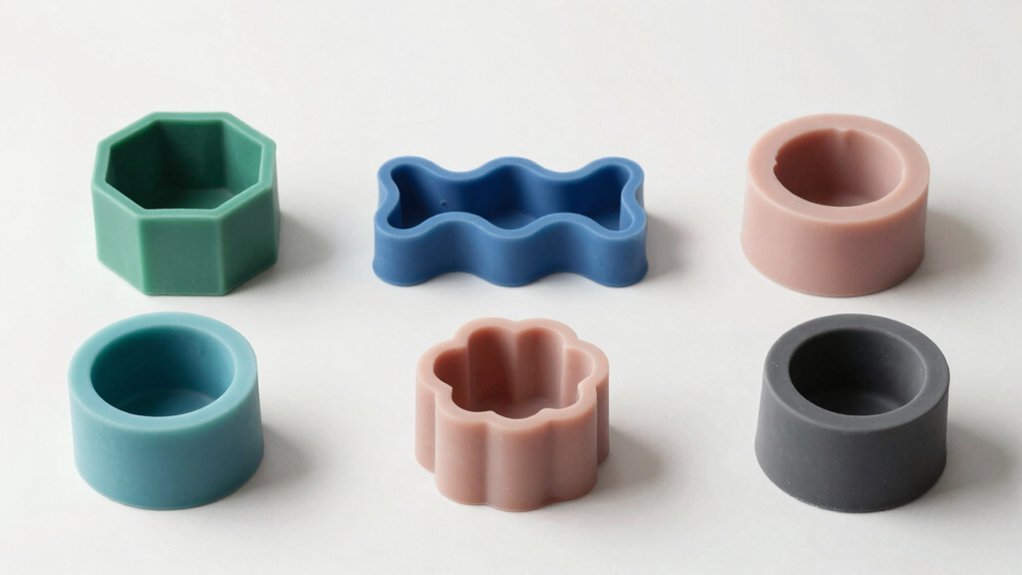
Unlike standard silicone molds, these custom dimensions allow you to create shorter soap loaves, helping you meet diverse market demands efficiently.
Troubleshooting Common Construction Issues
Building your wooden soap mold correctly the first time prevents frustrating issues down the line. When constructing your mold, guarantee all wood pieces are precisely cut and smoothly sanded to avoid splinter hazards during assembly and use.
To prevent common construction problems, follow these vital steps:
- Use clamps to hold sideboards firmly while drilling bolt holes, guaranteeing perfect alignment and uniform soap shapes.
- Pre-drill holes carefully, especially in pine, to prevent wood splitting when installing screws and bolts.
- Verify that the end board heights extend at least one inch above your planned soap level.
Remember to inspect and tighten all hardware regularly after removing soap batches. This maintenance step prevents loose components from compromising your mold's structural integrity, guaranteeing consistent, professional results with every pour.
Frequently Asked Questions
What Is the Best Wood for Soap Molds?
You'll find poplar is your best choice for soap molds, as it's durable and provides excellent insulation. If you need an alternative, Baltic birch plywood offers great stability and won't warp easily.
What Is the Best Material for a Soap Mold?
You'll find untreated wood like poplar or Baltic birch plywood is your best choice for soap molds. They're durable, provide excellent insulation, and won't contaminate your soap with chemicals during the curing process.
Can I Make My Own Soap Molds?
Yes, you can easily make your own soap molds using poplar wood. You'll need basic tools like a drill and screws, and remember to line your mold with freezer paper before use.
Do You Need to Grease Soap Molds?
You don't need to grease soap molds if they're properly lined with freezer paper or if you're using silicone molds. Both options provide natural non-stick surfaces that make soap removal easy without additional lubrication.
In Summary
You'll find that building your own wooden soap molds for commercial production saves significant money while giving you full control over your soap-making process. Whether you're making simple bars or intricate designs, these custom molds will serve you well for years with proper maintenance. Start with basic designs, then expand your collection as your business grows. Remember – quality materials and precise construction are your keys to success.


Leave a Reply