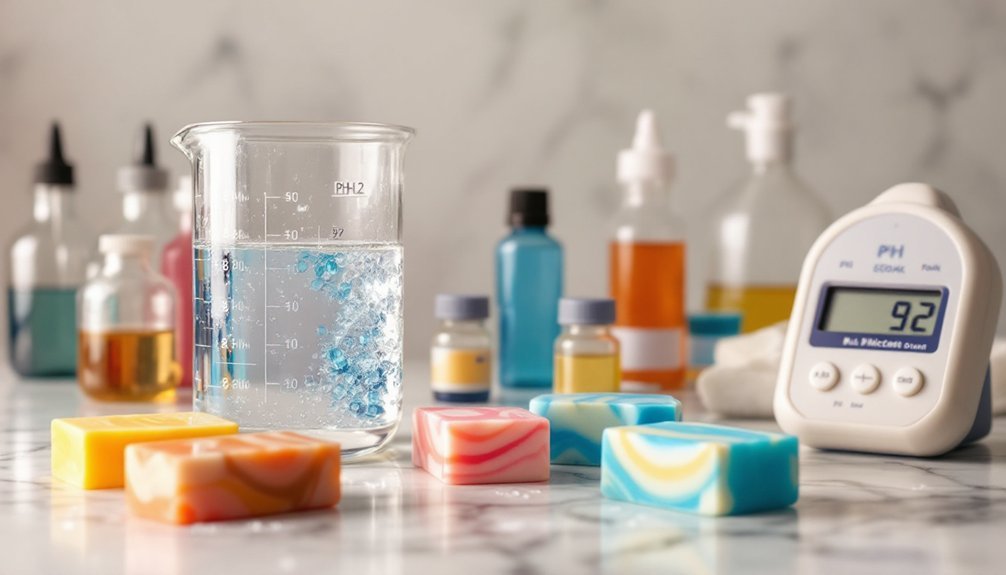
Soap requires a pH between 8-10 because this alkaline range enables it to effectively break down oils and wash away dirt while remaining gentle enough for your skin. At pH below 8, soap loses cleansing power and leaves residue, while above 10 risks irritating your skin and damaging its protective barrier. This ideal range allows soap molecules to emulsify grease and kill bacteria while respecting your skin's natural chemistry. The perfect balance offers both cleanliness and comfort.
The Science Behind Soap's Alkaline Nature

When you lather up with your favorite bar of soap, you're utilizing a carefully balanced chemical product. This balance hinges primarily on pH—specifically, an alkaline pH between 8 and 10 that results from saponification, the chemical reaction between fats and lye (sodium hydroxide).
This alkalinity serves an essential purpose. At this pH range, soap effectively emulsifies oils and breaks down dirt, making it ideal for cleansing. Anything lower wouldn't clean properly, while anything above 11 could damage your skin.
Though your skin's acid mantle naturally maintains a pH around 5.5, properly formulated soap works without disrupting this balance. The alkaline nature also promotes lathering, enhancing the soap's application and effectiveness while remaining gentle enough for regular use.
How Ph 8-10 Enables Effective Cleansing

The specific pH range of 8-10 lies at the heart of soap's remarkable cleaning power. At this ideal alkaline level, soap molecules effectively break down oils and grease, transforming them into smaller particles that water can easily wash away. This chemical process enhances soap's ability to lift impurities from surfaces and skin.
You'll notice that when soap falls below pH 8, it loses much of its cleansing capability, struggling to dissolve stubborn grime and bacteria.
Conversely, pushing beyond pH 10 risks skin irritation as the solution becomes too harsh for regular use.
The beauty of properly formulated soaps within this pH range is their ability to thoroughly clean while respecting your skin's natural oils. This balance creates perfect conditions for removing dirt without compromising your skin's protective barrier.
Balancing Cleansing Power With Skin Compatibility

Finding the perfect balance between cleansing power and skin compatibility presents a fascinating challenge in soap formulation.
While your skin maintains a pH of approximately 5.5, soap requires higher pH levels (8-10) to function properly. This alkaline nature guarantees effective saponification—the chemical process that breaks down oils and dirt.
You'll notice that soaps with pH below 8 often leave residue on your skin due to incomplete cleansing action. Conversely, products exceeding pH 10 can disrupt your skin's protective barrier, increasing irritation risk and causing dryness with prolonged use.
The sweet spot between 8 and 10 optimizes cleansing power while respecting your skin's natural chemistry.
This careful balance allows soap to remove unwanted substances efficiently without compromising the acid mantle that's vital for maintaining overall skin health.
The Role of Saponification in Establishing Soap Ph

At the heart of every bar of soap lies saponification, a remarkable chemical transformation that establishes the essential alkaline properties. When lye reacts with fatty acids in oils, it creates soap molecules that naturally exhibit an alkaline nature, typically settling into a pH range of 8-10 after proper curing.
This pH range isn't arbitrary—it's precisely what enables soap's effective cleaning properties. At pH 8-10, soap molecules optimally emulsify and lift away dirt and oils from surfaces. You'll find this balance critical for performance; anything below 8 reduces cleaning power, while exceeding 10 signals potential excess lye that could irritate your skin.
The controlled saponification process guarantees your soap maintains ideal skin compatibility while still providing the alkaline environment necessary for effective cleansing.
Dangers of Soap With Ph Above 10

When you use soap with a pH above 10, you're exposing your skin to harsh alkaline conditions that can cause irritation, redness, and uncomfortable dryness.
These highly alkaline products strip away your skin's protective barrier and natural oils, leaving you vulnerable to bacterial infections and chronic skin conditions like eczema.
Your skin's acid mantle becomes compromised, potentially triggering a cascade of issues from excessive dryness to hypersensitivity that won't quickly resolve even after switching to gentler cleansers.
Skin Irritation Risks
Although soap plays an essential role in our hygiene routines, products with a pH above 10 can pose serious risks to your skin's health. Your skin naturally maintains an acidic environment with a pH around 5.5, creating what's known as your natural acid mantle. High pH soaps disrupt this balance, potentially leading to significant skin irritation.
When you use soaps exceeding pH 10, you're likely stripping away essential oils, causing dryness, redness, and itching. This can trigger skin barrier dysfunction, increasing your vulnerability to infections and environmental irritants.
The damage doesn't stop there—your skin's microbiome, which thrives in slightly acidic conditions, becomes compromised.
For those with existing conditions like eczema or dermatitis, these alkaline products can be particularly problematic, increasing water loss through the skin and exacerbating symptoms.
Harsh Chemical Exposure
Soaps with pH levels exceeding 10 contain particularly aggressive alkaline compounds that do more than just irritate your skin—they can damage it at a chemical level.
When you use a high pH product regularly, you're basically stripping away your skin's natural acid mantle, which normally maintains a protective pH of 5.5.
Alkaline soap with pH values of 11 or higher can cause chemical burns, especially if you have sensitive skin.
You'll notice immediate discomfort, but the long-term damage is more concerning. These harsh products disrupt your skin microbiome, eliminating beneficial bacteria that protect against infections.
The chemical assault from extremely high pH soaps doesn't just cause temporary dryness—it fundamentally alters your skin's ability to retain moisture, potentially leading to chronic dermatitis and increased vulnerability to environmental irritants.
Depletes Natural Oils
Your skin's delicate oil balance faces serious disruption from soaps with pH levels above 10, which aggressively strip away sebum—your body's natural moisturizer.
This excessive cleansing power leaves your skin vulnerable and compromised.
When you use highly alkaline soap, you'll notice immediate tightness and discomfort—clear signals that your skin's protective barrier is being damaged.
Over time, this harsh cleansing process doesn't just remove dirt; it eliminates essential natural oils your skin needs to maintain proper hydration and defense against environmental stressors.
The ideal soap pH (between 8-10) strikes a vital balance: strong enough to cleanse effectively while gentle enough to preserve your skin health.
Anything higher risks long-term damage, including altered microbiome composition that can trigger irritation, eczema, or dermatitis.
Your skin deserves cleansing that respects its natural chemistry.
Why Soap Below Ph 8 Loses Effectiveness
When the pH of soap dips below 8, its fundamental cleaning mechanisms begin to break down. Without sufficient alkalinity, soap simply can't perform its primary function of breaking down oils and dirt on your skin.
The chemistry of saponification—the process that transforms oils into soap—requires this higher pH range to work properly.
You'll notice three significant issues with low-pH soap:
- Inadequate cleansing power due to incomplete saponification, leaving oils unconverted
- Reduced lather production, which diminishes the soap's ability to lift away impurities
- Formation of excess free fatty acids that leave a greasy residue rather than a clean feeling
While your skin's natural pH hovers around 5.5, soap needs to maintain its alkaline properties to be effective—too low, and you'll experience both poor cleaning results and potential skin irritation.
Testing Methods to Verify Your Soap's Ph Level
Accurately determining your soap's pH level stands as a critical quality control measure for both hobbyists and commercial manufacturers alike. For reliable results, create a 1% solution by mixing 1 gram of soap with 99 grams of distilled water before testing.
While pH strips offer convenience, they're often unreliable for soap pH measurement due to soap's colloidal nature. Instead, invest in digital pH meters that provide precise readings—just remember to calibrate them with standard buffer solutions first.
For thorough assessment, employ multiple testing methods to cross-verify your results. Timing matters too; test your cold process soap after its full 4-6 week curing period to obtain accurate readings that reflect the final product's true pH.
This guarantees your soap maintains the ideal 8-10 pH range for effective cleaning.
Natural Ingredients That Influence Soap's Ph
While creating handmade soap involves artistic creativity, the underlying chemistry determines its performance on skin. The delicate balance of ingredients directly impacts your soap's final pH range, which affects skin compatibility.
Natural oils like olive, coconut, and sunflower are fundamental to soap making, reacting with lye during saponification to create an alkaline product with pH levels between 9-11.
When formulating your recipe, consider:
- The type and quantity of lye (sodium hydroxide) you use, as it's the primary driver of alkalinity
- Moisturizing additives such as shea and cocoa butter, which help maintain a balanced pH between 8-10
- Essential oils that may slightly offset alkalinity with their natural acidic properties
Even colorants like spirulina can subtly alter pH, requiring careful formulation for ideal results.
Adjusting Ph in Cold Process vs. Hot Process Soaps
You'll face distinct challenges when adjusting pH levels in cold process versus hot process soaps due to their different production methods.
Cold process requires precision in initial formulation and potentially citric acid corrections after curing, while hot process allows for more immediate pH adjustments during the cooking stage.
Testing methods also differ—cold process typically requires waiting through the cure period before accurate pH testing, whereas hot process soaps can be tested much sooner after production.
Subheading Discussion Points
When comparing pH adjustment methods between soap-making processes, understanding the fundamental differences becomes essential for crafting skin-safe products.
Both cold process and hot process soap require careful pH testing to achieve that ideal 8-10 range that balances cleansing properties without causing skin irritation.
- Cold process soap typically starts with a higher pH (9-10) and requires precise lye measurement during formulation—any miscalculation leads to lye-heavy bars that could harm skin.
- Hot process soap achieves safe pH levels faster due to the cooking method that helps neutralize excess lye, making these soaps usable within just a week.
- Experienced soap makers monitor pH throughout production, knowing that properly formulated soaps naturally fall within the 8-10 range, offering effective cleansing while remaining gentle enough for regular use.
Testing Methods Differ
Although both soap-making processes aim for the same pH target, testing methods for cold and hot process soaps differ markedly due to their distinct curing timelines.
With cold process soap, you'll need patience before accurate pH testing can occur. Wait 4-6 weeks while saponification completes naturally and pH stabilizes to 8-10. Testing prematurely may yield inconsistent results due to uneven saponification throughout the bar.
In contrast, hot process soap can be tested much sooner—often within a week of production—since the cooking process accelerates saponification, creating more consistent pH levels immediately.
For both methods, create a diluted soap solution using 1 gram of soap dissolved in 9 grams of distilled water before testing. This dilution guarantees accurate readings that reflect the true pH of your soap, confirming it's safe for skin use.
Lye Concentration Effects
The single most influential factor in determining your soap's final pH is lye concentration.
When making cold process soap, you'll notice pH levels typically range between 9-11 due to excess lye needed for complete saponification.
Hot process soap often achieves slightly lower pH values since the cooking accelerates the chemical reaction.
To achieve the ideal 8-10 pH range without causing skin irritation:
- Adjust your lye concentration carefully – higher amounts create higher pH, while lower amounts can bring pH closer to 8
- Consider processing method – hot process soaps need less curing time to stabilize pH (less than a week) versus cold process (4-6 weeks)
- Test pH before use – proper curing allows excess lye to fully react with oils, gradually lowering pH to safer levels
The Skin's Acid Mantle and How It Recovers After Washing
Our skin maintains a delicate protective barrier known as the acid mantle, which naturally sits at a pH of approximately 5.5. This slightly acidic environment serves as a healthy barrier against harmful bacteria and pathogens that might otherwise colonize your skin.
When you wash with soap, your skin's pH temporarily rises above its natural level. Don't worry—your skin is remarkably resilient. In most cases, the acid mantle recovers within 1-2 hours after cleansing, returning to its ideal pH level.
However, long-term exposure to extremely alkaline products can disrupt this recovery process, potentially causing dryness and irritation.
That's why properly formulated soaps with pH between 8-10 strike an ideal balance—alkaline enough to cleanse effectively while still gentle enough to preserve your skin's natural defenses.
Debunking Ph Marketing Myths in Commercial Products
You've likely noticed "pH-balanced" splashed across soap packaging, but this marketing buzzword often lacks scientific backing for its implied superiority over traditional soaps.
Manufacturers routinely misrepresent pH testing results, creating fear about alkaline soaps while concealing the harsh surfactants in their seemingly gentle products.
The science actually shows that properly formulated soaps with pH levels between 8-10 clean effectively without harming your skin's acid mantle, contrary to what commercial soap companies want you to believe.
Buzzword Without Substance
While browsing beauty aisles, you've likely encountered countless products boasting "pH-balanced" formulations that promise healthier skin. This buzzword cleverly distracts you from what truly matters: proper formulation and ingredient quality.
The pH-balanced marketing tactic falls short in several ways:
- Alkaline soaps with pH between 8-10 are perfectly safe for your skin when properly formulated, despite fear-based marketing suggesting otherwise.
- Your skin's acid mantle naturally restores itself shortly after cleansing, making the pH panic largely unwarranted.
- Focusing on pH alone diverts attention from harsh synthetic ingredients that pose greater risks to skin health.
Rather than fixating on pH numbers, consider the complete formula. A well-crafted soap with quality ingredients will deliver superior cleaning effectiveness without compromising your skin's natural balance.
Label Claims vs. Science
Commercial skincare brands have mastered the art of scientific-sounding marketing that rarely aligns with actual chemistry. When you see "pH balanced" plastered across product labels, you're witnessing clever marketing rather than meaningful science.
The reality? Your skin's acid mantle (pH 4.5-6.2) naturally rebounds after temporary exposure to alkaline soaps (pH 8-10). These natural soaps effectively cleanse without causing the irritation that marketing claims would have you fear.
Ironically, many synthetic cleansers advertised as "skin-friendly" because of their low pH actually contain harsh surfactants that damage your skin more than a properly formulated alkaline soap ever would.
Don't let pH fearmongering steer you away from effective natural soaps. The complete formulation matters far more than pH alone when it comes to maintaining skin health.
Ph Testing Misrepresentations
Despite what glossy advertisements suggest, those pH test strips dramatically changing colors in commercials rarely tell the complete truth about skincare products.
The marketing misrepresentations around pH have created unnecessary fear of alkaline soaps, when properly formulated natural soaps with pH between 8-10 actually support effective cleansing without compromising skin health.
When evaluating soap claims, remember:
- Your skin quickly restores its natural acidity after washing with alkaline soap, making the "pH balanced" claim largely irrelevant.
- Many commercial products highlighting low pH often contain synthetic ingredients that may be more harmful than a soap's alkaline pH.
- Natural soaps with higher pH levels (8-10) can be gentler and more beneficial than synthetic "pH balanced" alternatives that simply mimic skin's acidity.
Formulating Balanced Soaps for Different Skin Types
Because each person's skin has unique characteristics and needs, formulating balanced soaps requires careful consideration of pH levels for specific skin types.
While soap naturally requires a pH between 8-10 to function effectively, you'll find variations within this range that better suit your particular skin condition.
If you have oily skin, you'll benefit from soaps closer to pH 10, which provide stronger cleansing properties to remove excess sebum.
Conversely, sensitive or dry skin responds better to formulations near pH 8, minimizing irritation while maintaining adequate cleansing.
The goal is creating balanced soaps that don't stray too far from your skin's natural pH of 5.5, preventing disruption of its protective acid mantle.
Adding organic oils and natural additives can enhance moisture retention and soothe skin conditions, bridging the gap between soap's necessary alkalinity and your skin's needs.
Frequently Asked Questions
Why Is Ph Level Important in Soap?
The pH level in soap determines how effectively it cleans without damaging your skin. You'll want a balanced pH (8-10) that removes dirt while protecting your skin's natural barrier from irritation and dryness.
What Is the Difference Between Ph 8 and 10?
At pH 8, you'll find soap that's milder on your skin while still cleansing effectively. pH 10 soaps provide stronger cleaning power and more lather, but they're potentially more irritating with regular use.
What Happens if Soap Is Too Alkaline?
If your soap's too alkaline, it'll strip natural oils from your skin, disrupt your acid mantle, and cause irritation, dryness, and sensitivity. You might experience tightness, burning sensations, and increased risk of infections.
Is 9.5 Ph Soap Good?
Yes, 9.5 pH soap is good for your skin. It's within the ideal 8-10 range, providing effective cleansing while remaining gentle enough. You'll get clean skin without stripping away natural moisture.
In Summary
You've now discovered why soap needs that 8-10 pH sweet spot: it balances effective cleaning power with skin safety. Too acidic, and your soap won't clean properly; too alkaline, and it'll damage your skin. Remember, your skin's acid mantle will recover from properly formulated soap. When making or buying soap, prioritize this balanced pH range for ideal cleansing that respects your skin's natural chemistry.


Leave a Reply