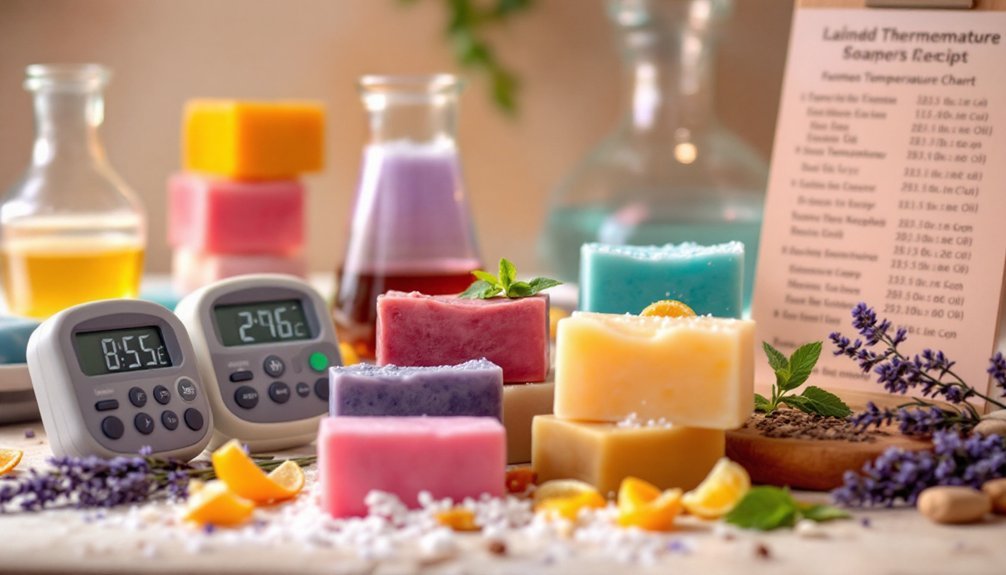
Soap recipes require different temperatures based on the type you're making. For cold process soap, keep oils and lye between 90-110°F, while hot process needs 131-160°F during cooking. Milk-based soaps demand cooler temperatures (90-100°F) to prevent scorching, and high-butter formulations work best at 90-110°F. Essential oils should be added around 100°F for ideal scent retention. You'll also need to adjust your temperatures seasonally to control trace and working time.
What Temperature Should Different Soap Recipes Follow?
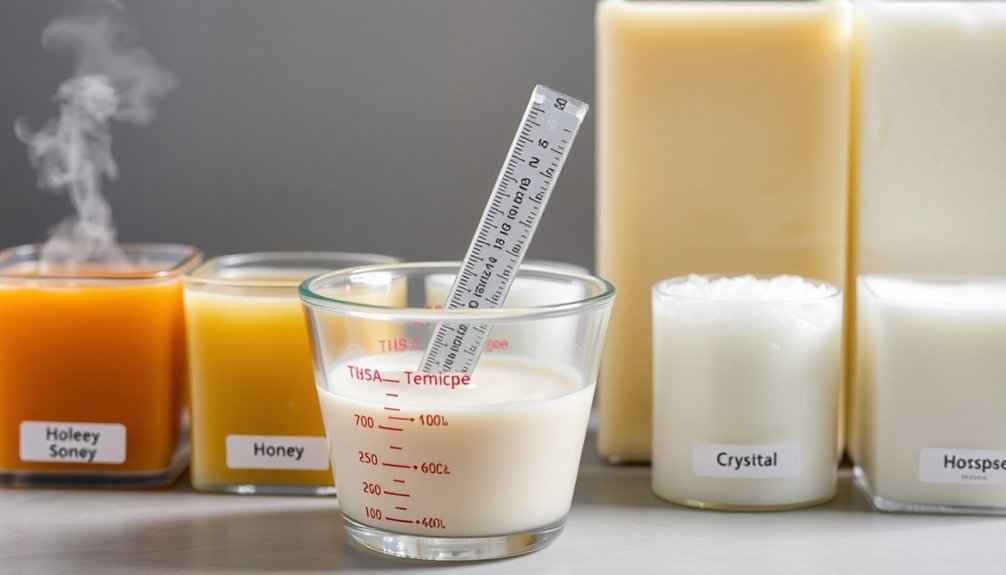
Monitoring the right temperature is one of the most critical aspects of successful soapmaking. For cold process soap making, you'll want both your oil mixture and lye temperatures between 90-110°F (32-43°C). This ideal temperature range guarantees proper saponification while helping you avoid false trace issues.
When working with hard oils and butters, maintain them around 120°F (49°C) to guarantee complete melting and uniform distribution. If you're aiming for vibrant colors or want to reduce soda ash, consider the higher end of the range (120-130°F).
Hot process soap requires higher temperatures since you're accelerating the saponification reaction with external heat. Always keep your oil mixture and lye temperatures within 10°F of each other to prevent separation problems during mixing.
The Science Behind Temperature in Soap Making
While many crafters focus on ingredients, temperature plays an equally essential role in the chemical reactions that transform oils and lye into soap. The saponification process functions best between 90°F to 110°F (32°C to 43°C), where oils and lye interact efficiently.
Temperature directly affects trace—the point where soap batter begins to thicken. Higher temperatures accelerate trace and minimize soda ash formation, while cooler conditions slow it down, allowing time for intricate designs in cold process methods.
When your oils and lye aren't within 10 degrees of each other (ideally 120-130°F), you risk false trace, where premature thickening occurs before proper saponification. This happens when fats solidify rather than react chemically with lye.
The heat transfer method cleverly uses the lye solution's heat to melt solid oils, ensuring smooth integration.
Basic Temperature Guidelines for Cold Process Soap
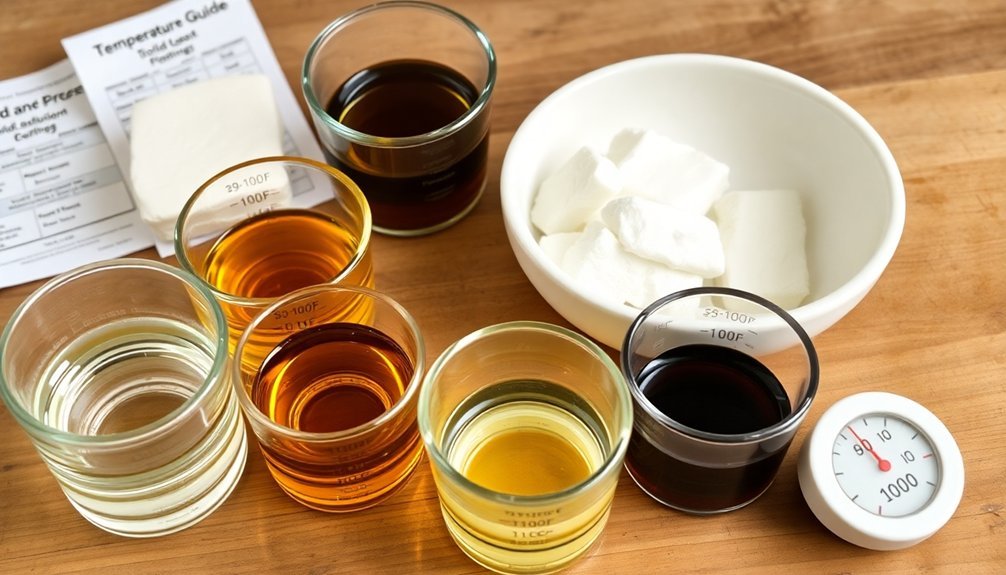
Three key temperature ranges govern successful cold process soap making. For most soap recipes, aim to keep your oils and lye solution between 90°F to 110°F (32°C to 43°C) when combining them. This range guarantees proper saponification while preventing false trace or acceleration issues.
Always keep your oils and lye water temperatures within 10 degrees of each other to achieve smooth emulsification.
For recipes with hard oils or butters, heat them to 120°F-130°F (49°C-54°C) to guarantee complete melting before cooling to your target temperature.
Cool your lye water to approximately 120°F (49°C) before mixing with oils. Higher temperatures for soap making (above 120°F) can promote gel phase and vibrant colors, while cooler temperatures slow the process, giving you more time before trace occurs.
Hot Process Soap Temperature Requirements
When making hot process soap, you'll want to maintain a cooking temperature between 131°F to 160°F (55°C to 71°C) to guarantee proper saponification while preventing defects.
Set your stove to low or medium-low heat, adjusting as needed to keep the soap mixture from overheating and causing problems like alien brain formation or soap volcanoes.
Unlike cold process methods, you can add hot lye directly to warm oils, which accelerates the reaction and simplifies your temperature management throughout the process.
Cooking Temperature Range
Since hot process soap making accelerates saponification through applied heat, maintaining the proper temperature range is critical to your success.
You'll want to keep your soap mixture between 131°F and 160°F (55°C to 71°C) throughout the cooking process. This temperature range promotes the gel phase, which enhances color vibrancy while reducing soda ash formation on your finished bars.
- Warm and melt your oils directly in the cooking pot before adding the lye solution
- Add your lye solution while it's still hot—no cooling necessary
- Monitor temperatures consistently to stay within the ideal cooking temperature range
- Adjust heat as needed, but don't worry about minor fluctuations—hot process soap is forgiving
- Continue cooking until the soap passes the "zap test" and completes saponification, allowing for use within days rather than weeks
Optimal Stove Settings
Controlling your stove settings properly forms the foundation of successful hot process soap making. When melting your oils, aim for low to medium heat to achieve the recommended 120-130°F range. This temperature creates suitable conditions for adding your lye solution.
For ideal stove settings, use a gentle simmer rather than high heat once you've combined ingredients. Maintain your soap mixture between 130-160°F during the cooking phase to guarantee proper saponification without risking overheating. If your temperatures climb above 160°F, reduce heat immediately to prevent glycerin rivers and other defects.
Unlike cold process methods, your lye solution doesn't require cooling before mixing, though keeping it around 120-130°F offers the best results.
Use a reliable thermometer to monitor temperatures throughout the process for consistent, high-quality soap.
Preventing Heat Issues
Although many soapmakers focus primarily on ingredients, temperature management remains critical for preventing common hot process soap failures.
You'll achieve better results by maintaining oil temperatures between 131°F and 160°F to promote the gel phase. Even though hot process is more forgiving than cold process, proper temperature control still matters for quality soap.
- Warm your oils in the cooking pot before adding lye to prevent false trace and accelerate saponification
- Use higher temperatures strategically to enhance colors and reduce soda ash formation
- Monitor constantly to avoid acceleration that leads to "alien brain" defects when getting too hot
- Skip cooling the lye solution—hot lye added to warm oils actually improves the reaction
- Balance heat carefully as cool temperatures can slow the process while excessive heat creates glycerin rivers
Temperature Considerations for Milk-Based Soap Recipes
Temperature plays a critical role when you're making milk-based soaps, requiring you to cool your lye solution to around body temperature (90-100°F) before combining it with oils.
You'll need to monitor this cooling process carefully, as temperatures exceeding this range can scorch the milk proteins and discolor your final product.
For best results, consider using frozen milk rather than fresh, which helps maintain lower temperatures throughout the saponification process and prevents unwanted curdling.
Cooling Lye Properly
When crafting milk-based soaps, you'll need to pay special attention to lye temperatures to preserve the milk's beneficial properties. Properly cooling your lye solution to 120-130°F (49-54°C) before combining it with oils is crucial to prevent scorching the milk.
Since milk can scorch at temperatures above 160°F (71°C), monitoring both lye and oil temperatures throughout your soap-making process guarantees consistent results.
- Prepare your lye solution 1-3 hours in advance to allow sufficient cooling time
- Utilize the heat transfer method to melt solid oils while keeping your lye solution cool
- Remember that milk contains additional sugars that can caramelize if your lye gets too hot
- Keep a thermometer handy to verify your lye solution has reached the ideal temperature range
- Consider using an ice bath to accelerate the cooling process when you're short on time
Preventing Milk Scorching
The delicate nature of milk-based soaps requires precise temperature management to preserve milk's beneficial properties. When working with milk recipes, always keep your lye solution below 120°F (49°C) to prevent milk scorching, which can damage its nutritional value and alter your soap's final quality.
Try these effective temperature control strategies: cool your lye solution to body temperature (around 98.6°F) before combining with oils, use frozen milk cubes instead of liquid milk to slow the heating during the saponification process, or incorporate milk directly into your oils rather than the lye solution. This provides a protective buffer against heat damage.
For ideal results, maintain your overall soap mixture between 100°F and 110°F (38°C to 43°C), creating the perfect balance for successful milk-based soap creation.
Managing Temperatures for High-Butter Soap Formulations
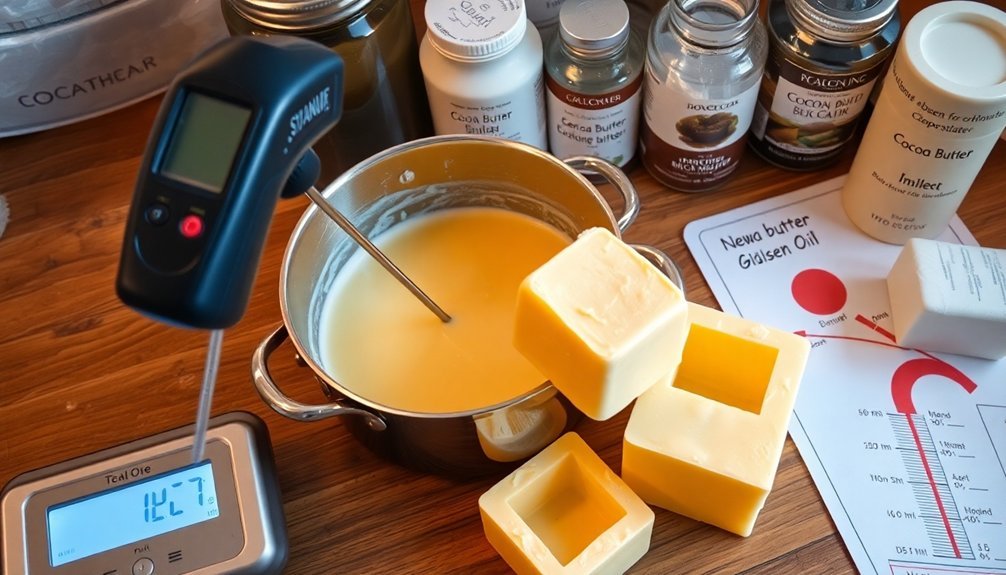
Several essential temperature considerations come into play when working with high-butter soap formulations.
You'll need to maintain temperatures between 90°F-110°F (32°C-43°C) to properly melt cocoa and shea butters without triggering false trace. When mixing your soap batter, remember that hard oils and liquid oils require different thermal management to achieve a smooth, homogeneous mixture.
- Keep your lye solution above 120°F (49°C) to help melt stubborn hard oils during incorporation
- Monitor specific melting points: cocoa butter (93°F/34°C) and shea butter (84°F/29°C)
- Use heat transfer method to leverage lye solution's warmth for melting solid butters
- Reduce temperatures slightly for intricate designs to slow trace development
- Verify all butters are fully melted before combining to prevent streaking or spots
Temperature Control for Essential Oil and Fragrance Preservation
Preserving the full aromatic properties of your fragrance materials requires careful temperature management during the soap-making process. For best fragrance retention, keep your soap mixture below 120°F (49°C) when adding essential oils or fragrance oils, as higher temperatures cause volatile compounds to evaporate, diminishing scent intensity.
Many fragrance oils perform best when incorporated at around 100°F (38°C), preventing scorching while maintaining their complex scent profiles. Working within the 100-110°F (38-43°C) soaping temperature range also helps you avoid glycerin rivers while maximizing scent longevity.
Consider using the heat transfer method to naturally achieve these ideal temperatures—this technique uses the heat from your lye solution to warm oils gently, ensuring proper mixing without exceeding temperature thresholds that would compromise your carefully selected scents.
Cold Weather vs. Hot Weather Soap Making Adjustments
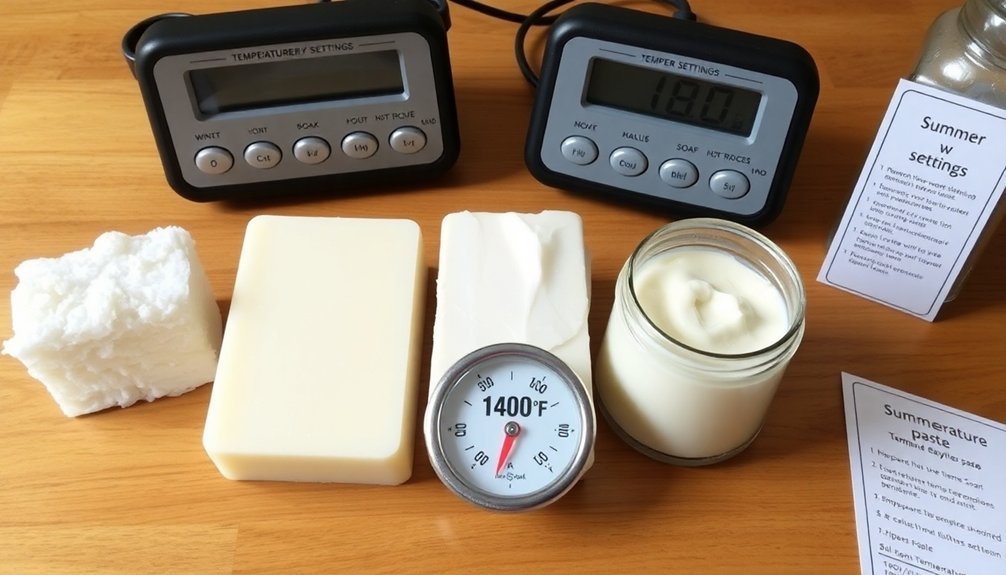
When seasons change, your soap making temperatures must adapt accordingly to maintain consistent results throughout the year.
In cold weather, keep oil and lye temperatures around 100°F to prevent false trace and separation issues. During hot weather, aim for 120-130°F to promote gel phase and enhance your soap's appearance.
- Cold weather requires fully melted hard oils to prevent graininess in your final soap.
- Hot weather needs careful temperature monitoring to avoid rapid saponification.
- Prepare your lye solution 1-3 hours beforehand to allow proper cooling or warming.
- Winter soaping below 100°F can cause premature thickening and separation.
- Summer temperatures above 130°F risk alien brain formations and glycerin rivers.
Adjust your approach with the seasons for beautiful soap year-round.
Using Temperature to Control Trace and Working Time
Temperature manipulation stands as one of the most powerful tools in a soap maker's arsenal for controlling trace and extending working time.
When making cold process soap, you'll find higher temperatures (120-130°F) accelerate trace, ideal for layered designs requiring quick setting. Conversely, working at lower temperatures (100-110°F) slows trace, giving you more time for intricate swirls and patterns.
Always consider the melting points of your oils and butters—cocoa butter needs at least 93°F and shea butter 84°F to remain fully melted.
The heat transfer method, where you add hot lye to water and then to oils of similar temperature, helps maintain consistency throughout the process.
Frequently Asked Questions
What Is the Best Temperature for Soap Making?
The best temperature for your soap making is between 90°F-110°F (32°C-43°C). You'll want to keep your oils and lye within 10°F of each other, ideally around 120-130°F for proper saponification.
What Is the Optimum Temperature for Saponification?
For ideal saponification, you'll want to maintain your soap mixture between 120-130°F (49-54°C). This temperature range guarantees your oils and lye combine properly without causing false trace or excessive acceleration during the process.
What Happens if You Use Cold Process Soap Too Soon?
If you use cold process soap too soon, you'll get a soft, crumbly bar that may irritate your skin. It won't lather well, could crack or lose shape, and might still contain active lye.
At What Temperature Does Homemade Soap Melt?
Your homemade soap typically begins to melt above 120°F (49°C). It's critical to monitor temperatures, as different oils in your recipe contribute to varying melting points, with complete melting occurring around 160°F (71°C).
In Summary
You've now mastered the temperature nuances for various soap recipes! Remember, you're in control—adjust your temps based on your ingredients, climate, and desired results. Whether you're working with delicate milk soaps at cooler ranges or pushing hot process batches to higher heats, you'll find that temperature management is your secret weapon for achieving the perfect trace, texture, and fragrance retention every time.